
Graphite Mechanical Seal for Chemical Pump
Description
Technical Parameters
Graphite Mechanical Seal for Chemical Pumps is manufactured from carbon graphite materials to provide reliable shaft sealing in chemical processing and liquid handling equipment.
The graphite seal face works with the mating ring to reduce leakage and friction while maintaining sealing performance under corrosive media, temperature variation and continuous pump operation. Different graphite material and impregnation options can be selected according to the pump medium and operating conditions.

Customizable content
| Customization Option | Available Choices |
|---|---|
| Material Type | Graphite, High-Density Graphite, Impregnated Graphite |
| Density (g/cm³) | 1.7, 1.9, 2.0 |
| Hardness (Shore) | 40, 50, 60 |
| Flexural Strength (MPa) | 50, 70, 100 |
| Compressive Strength (MPa) | 60, 80, 120 |
| Porosity (%) | 5%, 10%, 15% |
| Max Working Temperature (°C) | 150, 200, 250 |
| Grain Size (μm) | 10, 15, 20 |
| Application Medium | Strong Acid, Strong Alkali, Organic Solvents |
| Shape & Size | Round, Square, Custom Sizes (Specify Inner/Outer Diameter and Thickness) |
|
Type |
Impregnated material |
Bulk density (g/cm³) |
Hardness shore (HS) |
Flexural Strength (MPA) |
Compressive strength(MPA) |
Porosity ( %) |
Coeficient of expansion (10-6/oC) |
Max working temperature (oC) |
|
M106 G |
Silver(G) |
2.80 |
80 |
65 |
190 |
2.0 |
900 |
|
|
M106P |
copper(P) |
2.20 |
80 |
70 |
210 |
3.0 |
6.8 |
400 |
|
M106D |
Antimony(D) |
2.2-2.3 |
85 |
62 |
190 |
2.2 |
7.0 |
480 |
|
M154D |
2.2-2.3 |
70 |
55 |
150 |
2.2 |
7.0 |
480 |
|
|
M106A |
aluminium alloy(A) |
2.00 |
40 |
60 |
120 |
2.5 |
7.3 |
350 |
|
M106B |
Babbitt Alloy |
2.50 |
80 |
40 |
70 |
7.0 |
5.2 |
220 |
|
M106K |
resin |
1.75 |
80 |
60 |
176 |
1.0 |
4.0 |
200 |
|
M154K |
1.70 |
70 |
50 |
100 |
1.5 |
3.5 |
200 |
Seal Construction
Primary Seal Face
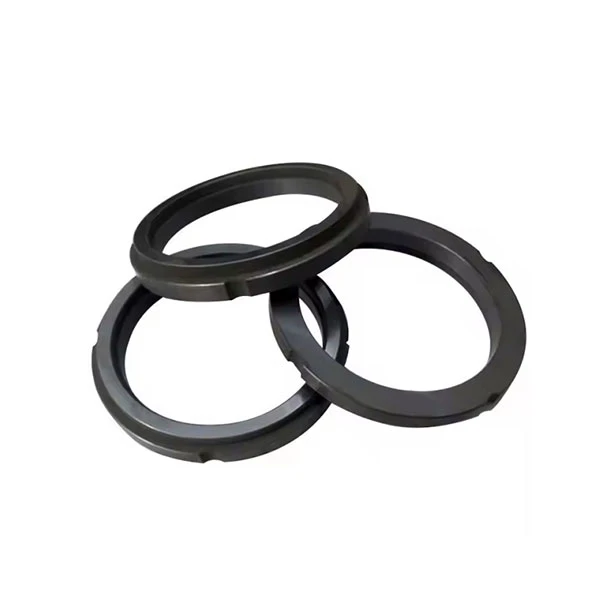
The graphite ring provides the primary sealing face against the mating ring and rotates or remains stationary according to the seal arrangement.
Mating Ring
The mating ring provides the opposing sealing face and works with the graphite ring to form the primary seal interface.
Spring Assembly
The spring applies axial closing force to maintain contact between the two sealing faces during shaft movement and rotation.
Secondary Seals
Secondary sealing elements seal the interfaces between the mechanical seal components and the shaft or housing.
Graphite Material Options
Carbon graphite grades can be selected according to the required chemical resistance, permeability, hardness, wear resistance and operating conditions.
|
Material Type |
Characteristics |
Typical Application |
|
Resin-Impregnated Graphite |
Reduced permeability and improved resistance to chemical penetration |
Chemical pumps, solvent pumps |
|
Antimony-Impregnated Graphite |
Higher hardness and wear resistance for demanding sealing conditions |
Higher-pressure sealing applications |
|
Metal-Impregnated Graphite |
Improved mechanical strength and thermal conductivity |
Heavy-duty rotating equipment |
Material Grade Selection
Material selection can be based on graphite grade, impregnation type, density, hardness, compressive strength, operating temperature, pressure and chemical medium.
For new applications or replacement seals, customers can provide the pump model, operating conditions or existing seal specification for material evaluation.
Product Features
Controlled Leakage
The graphite sealing face is lapped on a flat plate with fine abrasive to improve face flatness and contact uniformity with the mating ring, helping limit leakage.
Low-Friction Sliding
Graphite provides solid lubrication at the sealing interface, reducing friction and wear during continuous shaft rotation.
Reduced Permeability
Impregnation fills accessible pores in the graphite structure, reducing fluid penetration through the sealing material.
Chemical Resistance
Carbon graphite is resistant to many acidic, alkaline, and solvent-based media, supporting use in selected chemical pump services.
Thermal Stability
Low thermal expansion helps maintain the sealing-face geometry when operating temperature changes.

Applications
Chemical Transfer Pumps
For pumps handling acids, alkalis, solvents, and chemical solutions in liquid-transfer systems.
Chemical Process Pumps
For continuous circulation and transfer of process liquids in reactors, processing lines, and chemical production equipment.
Pharmaceutical Pumps
For liquid-transfer and circulation pumps used in pharmaceutical production and process systems.
Petrochemical Pumps
For process pumps used to transfer and circulate chemical and petroleum-based liquids.
Corrosive-Media Pumps
For selected pump services where the process medium requires a carbon-graphite sealing face rather than a conventional metal sealing material.
Seal Selection Information
|
Item |
Required Information |
|
Pump |
Manufacturer and pump model |
|
Seal Size |
Shaft or shaft-sleeve diameter |
|
Seal Type |
Existing seal type or part number |
|
Seal Faces |
Existing face material or seal specification |
|
Medium |
Chemical name and concentration |
|
Temperature |
Operating temperature |
|
Pressure |
Operating pressure |
|
Speed |
Pump shaft speed |
|
Rotation |
Shaft rotation direction, if applicable |
|
Installation |
Seal chamber or mounting dimensions |
|
Quantity |
Required quantity |
Factory & Manufacturing Capability
Graphite Seal Component Production
Carbon graphite materials are processed into mechanical seal faces, sealing rings, bushings and other precision sealing components according to specified dimensions and material requirements.
Multiple Graphite Impregnation Options
Resin, antimony and metal impregnation systems are available for different requirements involving permeability, hardness, chemical resistance, mechanical strength and thermal performance.
Seal-Face Machining & Lapping
Graphite sealing faces are precision-machined and lapped with dedicated equipment to control face geometry, flatness and surface condition before assembly.
Mechanical Seal Assembly
Graphite sealing rings are assembled with mating rings, springs, retainers and secondary sealing components according to the specified seal configuration.
Packaging & Delivery
|
Item |
Details |
|
Individual Protection |
Each mechanical seal is wrapped in PE film or protective bag and separated with foam or paper padding to prevent face-to-face contact and edge damage. |
|
Inner Packing |
10–20 pcs per inner carton for small and standard-size seals; each unit is separated to prevent rubbing during transport. |
|
Outer Carton |
5–10 inner cartons per export carton, depending on seal size and gross weight. |
|
Large / Heavy Seals |
Packed in reinforced cartons or plywood/wooden cases with internal cushioning and secure fixing. |
|
Quantity Marking |
Carton labels include product name, model/part number, size, quantity, gross weight, net weight, and country of origin. |
|
Palletizing |
Cartons can be placed on export pallets for larger shipments to facilitate forklift handling and container loading. |
|
Shipping |
Sea freight, air freight, or express according to order quantity and delivery requirement. |
|
Trade Terms |
EXW, FOB, CIF |
|
Export Documents |
Commercial Invoice, Packing List, Certificate of Origin, and other documents required for shipment. |

FAQ
Q: What causes a chemical pump mechanical seal to leak?
A: Common causes include damaged sealing faces, incorrect installation, shaft runout, excessive vibration, improper seal dimensions, and incompatible seal materials.
Q: Can a graphite mechanical seal run without oil lubrication?
A: Yes. The graphite sealing face provides solid lubrication, allowing suitable seal designs to operate without a separate oil supply at the sliding interface.
Q: Can graphite mechanical seals handle abrasive liquids?
A: Standard graphite sealing faces are not intended for heavily abrasive media. Abrasive particles can accelerate face wear and should be considered when specifying the seal.
Q: Can this seal replace a metal mechanical seal?
A: Yes, where the seal dimensions, face arrangement, process medium, temperature, pressure, and speed match the requirements of the pump.
Q: What is the difference between impregnated and unimpregnated graphite seals?
A: Impregnation fills accessible graphite pores and changes properties such as permeability, density, hardness, and mechanical strength.
Q: How should a mechanical seal be stored before installation?
A: Keep the seals dry, clean, protected from impact, and away from direct sunlight and chemical contamination. Sealing faces should remain protected until installation.
Q: Can I buy a replacement mechanical seal by pump model?
A: Yes. The pump manufacturer, pump model, existing seal part number, and shaft diameter can be used to identify the required seal configuration.
Q: What information should be provided for a replacement seal quotation?
A: Provide the pump model, existing seal reference, shaft diameter, medium, temperature, pressure, speed, and required quantity.
Hot Tags: graphite mechanical seal for chemical pump, China graphite mechanical seal for chemical pump manufacturers, suppliers, factory, Copper Carbon Block For Making Carbon Brush, graphite carbon mechanical seal, Graphite Mechanical Seal
Previous
No InformationNext
No InformationSend Inquiry