

High Pure Graphite Tube Used in Furnace
Description
Technical Parameters
High-Purity Graphite Furnace Tubes are manufactured for vacuum furnaces, inert-atmosphere furnaces, and high-temperature processing equipment where thermal stability, low thermal expansion, electrical conductivity, and controlled material purity are required.
Compared with conventional metal or ceramic components, graphite provides a combination of high-temperature capability, low thermal expansion and machinability, making it suitable for furnace tubes that require precise dimensions and stable performance during repeated heating cycles.
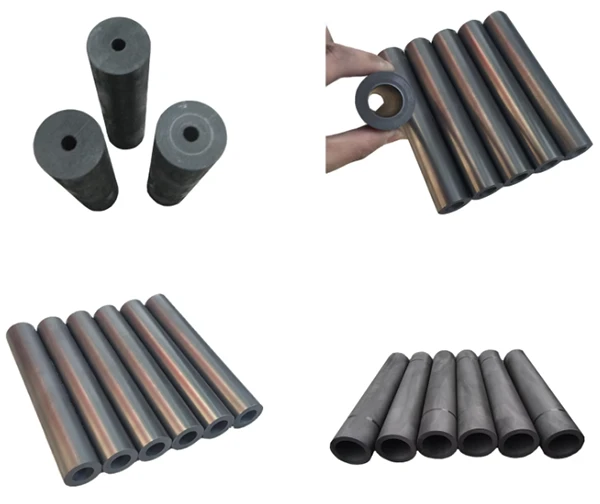
Graphite Tube material data sheet
| W-4 | W-5 | W-6 | W-7 | W-8 | WH-5 | WH-7 | WH-8 | ||
| Bulk density | G/cm³ | 1.75 | 1.85 | 1.9 | 1.82 | 1.9 | 1.68 | 1.85 | 1.9 |
| Resistivity | UΩm | 8-11 | 8-10 | 8-9 | 11-13 | 11-13 | 13-15 | 11-13 | 11-13 |
| Thermal conductivity(100℃) | W/m.k | 110-120 | 130-140 | 130-140 | 110-120 | 110-120 | 80-100 | 100-120 | 110-120 |
| Thermal expansion coefficient (room temperature - 600℃) | 10-6/℃ | 5.46 | 4.75 | 4.8 | 5.8 | 5.85 | 5.8 | 5.9 | 5.85 |
| Shore Hardness | HSD | 42 | 48 | 53 | 65 | 70 | 60 | 68 | 72 |
| Flexural strength | Mpa | 38 | 46 | 55 | 51 | 60 | 38 | 62 | 70 |
| Compressive strength | Mpa | 65 | 85 | 95 | 115 | 135 | 80 | 135 | 160 |
| Elastic modulus | GPa | 9 | 11.8 | 12 | 12 | 13 | 8.8 | 12 | 13 |
| Porosity | % | 17 | 13 | 11 | 12 | 11 | 18 | 12 | 11 |
| Ash | PPM | 500 | 500 | 500 | 500 | 500 | 500 | 500 | 500 |
| Purification of ash | PPM | 50 | 50 | 50 | 50 | 50 | 50 | 50 | 50 |
| grain size | Um | 13-15 | 13-15 | 8-10 | 8-10 | 8-10 | 8-10 | 7 | 5 |
| Application | Common use | Common use | Continuous casting, sintering, high temperature metallurgy | EDM,Photovoltaic | EDM,Photovoltaic,GLASS | EDM | Common use,EDM | EDM,Photovoltaic,GLASS |
Furnace-Specific Tube Construction
Cylindrical Graphite Tube Body
The main tube body forms the cylindrical structure required for installation inside the furnace.
Continuous Internal Bore
The internal bore provides the required passage for heating elements, process materials, or controlled gas flow within the furnace assembly.
Defined Tube Wall
The graphite wall separates the internal bore from the surrounding furnace environment while providing the required structural support during high-temperature operation.
Performance in Furnace Service
High-Temperature Capability
Graphite can withstand extremely high temperatures up to approximately 3000°C under controlled inert atmospheres, depending on the selected graphite grade, furnace design, atmosphere, heating conditions, and operating environment.
Low Thermal Expansion
The graphite grades listed for this product have thermal expansion coefficients of 4.75–5.90 × 10⁻⁶/°C, helping limit dimensional changes during furnace heating and cooling.
Electrical Conduction
Graphite's electrical conductivity allows the tube material to function in furnace assemblies where electrical conduction or resistance-heating components are involved.
Controlled Material Purity
High-purity graphite and purification processes help control ash and metallic impurities, which is important in furnace processes where contamination of the working environment or processed material must be limited.
Furnace Atmosphere Compatibility
Vacuum Service
Suitable for vacuum furnace environments where graphite components operate under reduced-pressure conditions.
Argon & Nitrogen Atmospheres
Suitable for controlled high-temperature processes using argon, nitrogen, or other protective atmospheres that limit graphite oxidation.
Controlled Inert Atmospheres
Material and operating conditions should be selected to maintain graphite performance and minimize oxidation during high-temperature furnace operation.
Applications
Vacuum Furnaces
Used as heating support tubes, protection tubes, or process tubes in vacuum heat-treatment and high-temperature processing systems.
Inert Atmosphere Furnaces
Applied in furnaces operating under argon, nitrogen, or other controlled atmospheres where graphite can maintain high-temperature performance with limited oxidation.
Sintering Furnaces
Used as support, protection, or process tubes in high-temperature sintering of ceramics, powder metallurgy materials, and advanced materials.
Semiconductor Processing Equipment
Used where high-purity graphite components are required to support high-temperature processing while reducing potential contamination from metallic materials.
Heat Treatment Equipment
Applied in high-temperature heat-treatment systems requiring dimensionally stable graphite components for repeated heating and cooling cycles.
Other High-Temperature Furnace Systems
Used as customized furnace tubes, support tubes, protection tubes, and process components according to equipment design and operating conditions.
Customization
Tube Dimensions
Outer diameter, inner diameter, length, and wall thickness can be manufactured to specified dimensions.
End Geometry
Chamfers, steps, shoulders, grooves, and other end features can be machined for furnace assembly requirements.
Graphite Grade
W-series and WH-series graphite grades are available for different purity, density, porosity, strength, thermal, and electrical requirements.
Surface Requirement
Machining and grinding levels can be specified where a defined surface condition is required.
Replacement Production
Existing furnace tubes can be used as dimensional references when original drawings are unavailable.
ProTechnical Documents & Traceabilityducts Description
Material Documentation
Material data and applicable test results can be supplied for the specified graphite grade.
Dimensional Records
Dimensional inspection records can be provided for specified critical dimensions.
Batch Traceability
Batch or lot information can be recorded against the product specification and shipment for repeat-order identification.
Order Documentation
Commercial Invoice, Packing List, Certificate of Origin, and other required shipping documents can be provided with the order.
Packaging & Shipment
Individual Protection
Each graphite tube is separated and protected against direct impact, abrasion, and contact damage during handling.
Tube Support
Long or thin-wall tubes are supported within the package to reduce bending and impact loads during transportation.
Protective Export Packaging
Tubes are packed in cartons, wooden cases, or other suitable export packaging according to tube dimensions and shipment quantity.
Package Marking
Packages can be marked with the product name, graphite grade, dimensions, quantity, and batch/lot number for receiving inspection.
Pre-Shipment Check
Product quantity, dimensions, package condition, and identification are checked against the approved order before dispatch.
Manufacturing & Supply Capability
Graphite Material Processing
Production covers graphite preparation, purification, machining, grinding, inspection, and protective packaging for finished graphite components.
CNC Tube Machining
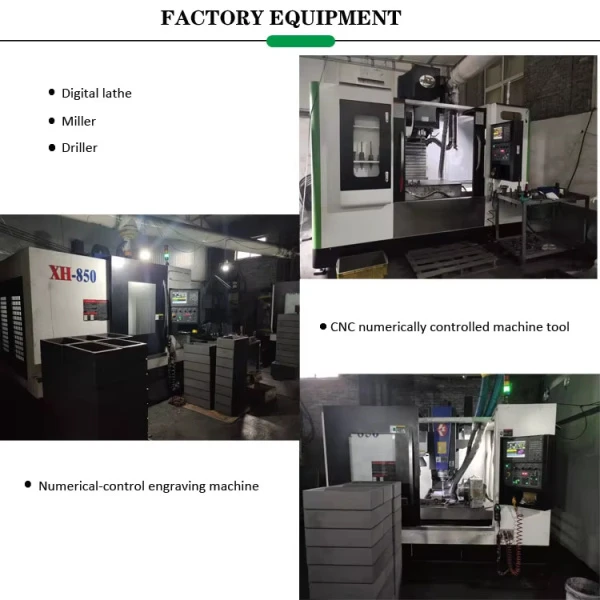
CNC machining supports the production of cylindrical graphite tubes with controlled OD, ID, length, wall thickness, internal bores, and machined end features.
Material Inspection
Applicable graphite grades are checked for defined material characteristics such as density, porosity, ash content, grain size, and mechanical properties.
International Supply
The company serves 500+ customers and exports graphite products to 50+ countries, supporting international orders with export packaging and documentation.
FAQ
Q: Can graphite furnace tubes be used for heating elements?
A: Yes. Graphite tubes can be used as heating-related components in furnace assemblies because graphite is electrically conductive and suitable for high-temperature service.
Q: Can graphite tubes be used inside a vacuum furnace?
A: Yes. Graphite tubes are commonly used in vacuum furnace assemblies where the process environment is maintained under reduced pressure.
Q: Can graphite tubes be used in a furnace with air?
A: Graphite oxidizes in oxygen-containing atmospheres at elevated temperatures, so unprotected graphite is not intended for high-temperature furnace operation in air.
Q: What causes graphite furnace tubes to crack?
A: Common causes include mechanical impact, excessive local loading, thermal shock, improper handling, and stress concentrations around machined features.
Q: Are graphite tubes electrically conductive?
A: Yes. Graphite is electrically conductive, and its electrical resistivity varies by graphite grade.
Q: Are graphite furnace tubes brittle?
A: Graphite is relatively brittle compared with metals and ceramics in terms of impact resistance, so tubes should be handled and installed without concentrated mechanical impact or excessive point loading.
Q: Can graphite furnace tubes be used as protective tubes?
A: Yes. Their tubular structure can provide physical separation between furnace components, process materials, and the surrounding furnace environment.
Q: What is the difference between a graphite tube and a graphite rod?
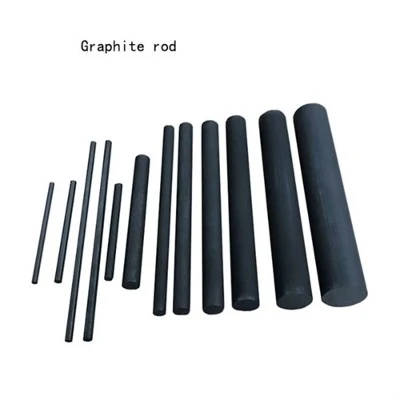
A: A graphite tube has a continuous internal bore, while a graphite rod is primarily solid. The tube is therefore used where an internal passage or hollow structure is required.
Q: Can graphite tubes be machined after graphitization?
A: Yes. Graphite tubes can be CNC-machined and ground after material processing to achieve the required cylindrical dimensions and surface condition.
Q: How should graphite furnace tubes be handled before installation?
A: They should be kept in protective packaging until installation and handled with clean, controlled contact to avoid impact, edge damage, and contamination of the machined surfaces.
Hot Tags: high pure graphite tube used in furnace, China high pure graphite tube used in furnace manufacturers, suppliers, factory, Copper Carbon Block For Making Carbon Brush, graphite tube, High Pure Graphite Tube
Previous
No InformationNext
No InformationSend Inquiry