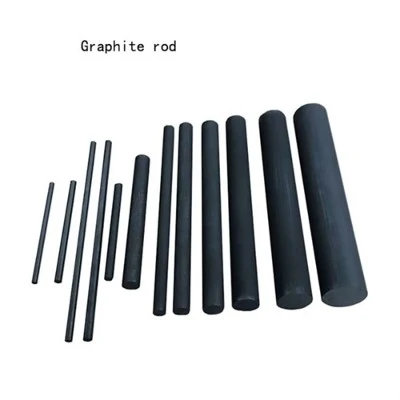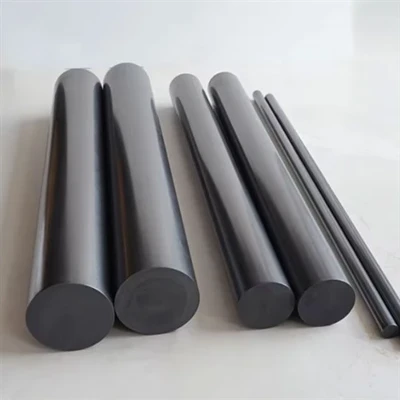

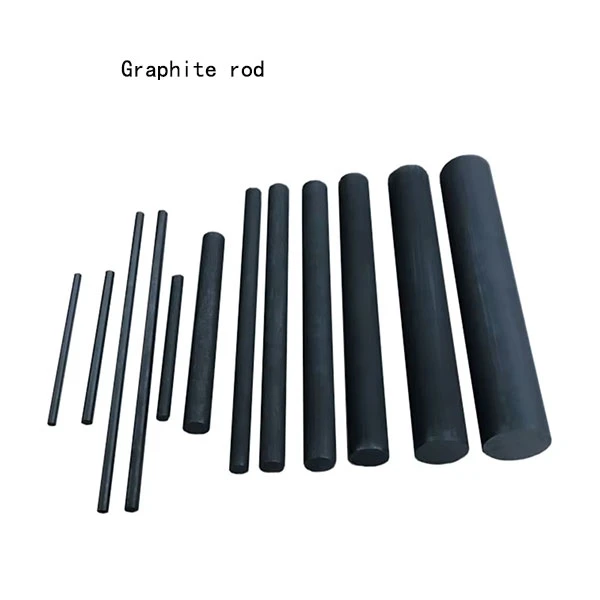
High Pure Small Graphite Rod Diameter 5/4/3/2/1mm
Description
Technical Parameters
High Purity Small Graphite Rods are precision-machined graphite components supplied in 1 mm, 2 mm, 3 mm, 4 mm, and 5 mm diameters for EDM electrodes, laboratory furnaces, electrical contacts, and high-temperature equipment requiring controlled dimensions, stable electrical conductivity, and high material purity. Manufactured from selected graphite grades, these small-diameter rods are suitable for miniature electrode and conductive components where compact geometry, machinability, and predictable material properties are required.

Graphite rod material data sheet for your reference
| W-4 | W-5 | W-6 | W-7 | W-8 | WH-5 | WH-7 | WH-8 | ||
| Bulk density | G/cm³ | 1.75 | 1.85 | 1.9 | 1.82 | 1.9 | 1.68 | 1.85 | 1.9 |
| Resistivity | UΩm | 8-11 | 8-10 | 8-9 | 11-13 | 11-13 | 13-15 | 11-13 | 11-13 |
| Thermal conductivity(100℃) | W/m.k | 110-120 | 130-140 | 130-140 | 110-120 | 110-120 | 80-100 | 100-120 | 110-120 |
| Thermal expansion coefficient (room temperature - 600℃) | 10-6/℃ | 5.46 | 4.75 | 4.8 | 5.8 | 5.85 | 5.8 | 5.9 | 5.85 |
| Shore Hardness | HSD | 42 | 48 | 53 | 65 | 70 | 60 | 68 | 72 |
| Flexural strength | Mpa | 38 | 46 | 55 | 51 | 60 | 38 | 62 | 70 |
| Compressive strength | Mpa | 65 | 85 | 95 | 115 | 135 | 80 | 135 | 160 |
| Elastic modulus | GPa | 9 | 11.8 | 12 | 12 | 13 | 8.8 | 12 | 13 |
| Porosity | % | 17 | 13 | 11 | 12 | 11 | 18 | 12 | 11 |
| Ash | PPM | 500 | 500 | 500 | 500 | 500 | 500 | 500 | 500 |
| Purification of ash | PPM | 50 | 50 | 50 | 50 | 50 | 50 | 50 | 50 |
| Grain size | Um | 13-15 | 13-15 | 8-10 | 8-10 | 8-10 | 8-10 | 7 | 5 |
| Application | Common use | Common use | Continuous casting, sintering, high temperature metallurgy | EDM,Photovoltaic | EDM,Photovoltaic,GLASS | EDM | Common use,EDM | EDM,Photovoltaic,GLASS |
Product Construction
Solid Graphite Rod
A solid cylindrical graphite body provides the continuous cross-section required for small-diameter electrode, conductive, and high-temperature components.
Uniform Diameter
The working section is machined to maintain a consistent diameter along the specified length, which is important for controlled electrical contact and dimensional fit.
Machined End Faces
The rod ends are cut and finished to provide defined contact surfaces for insertion, electrode connection, or component assembly.
Fine-Grain Graphite
Fine-grain graphite grades are available for small-diameter rods where a more uniform material structure and controlled machining surface are required.
Dimensional & Geometry Inspection
Diameter Accuracy
The diameter is measured at the two ends and middle section, with readings taken in two perpendicular directions at each position using a digital micrometer. The maximum and minimum measured values are recorded to identify diameter variation and checked against the specified diameter and tolerance.
Length Accuracy
Overall rod length is measured from end face to end face using a vernier caliper or length-measuring gauge. The measured value is recorded and compared with the specified length and tolerance.
Straightness Accuracy
The rod is positioned on a precision flat plate or inspection fixture, and a dial indicator is used to measure deviation along the rod while it is rotated or moved through the inspection position. The maximum deviation is recorded and compared with the specified straightness requirement.
Electrical & Thermal Characteristics
Electrical Resistivity
Available graphite grades have listed electrical resistivity of 8–15 μΩ·m, providing different conductivity levels for electrode and conductive applications.
Thermal Conductivity
The listed grades provide thermal conductivity of 80–140 W/m·K at 100°C, giving different heat-transfer characteristics for thermally loaded components.
Thermal Expansion
The listed thermal expansion coefficients are 4.75–5.90 × 10⁻⁶/°C from room temperature to 600°C, providing a defined basis for evaluating dimensional change during heating.
Grade-Based Property Selection
Electrical resistivity, thermal conductivity, and thermal expansion vary between graphite grades. These material parameters can be used to select the grade required by the customer's electrical and thermal specifications.
Applications
EDM Electrodes
Used for small EDM electrodes requiring electrical conductivity, controlled diameter, low electrode weight, and machinability for precision machining operations.
Laboratory Furnace Components
Used as small heating, support, or conductive graphite components in laboratory furnaces and experimental high-temperature equipment.
Electrical Contacts
Applied in conductive assemblies where graphite's electrical conductivity, thermal stability, and resistance to high-temperature conditions are required.
Semiconductor & Precision Equipment
Used for selected small graphite components in semiconductor and precision processing equipment where material purity, dimensional control, and low contamination are important.
High-Temperature Equipment
Used for small support, conductive, and process components exposed to elevated temperatures in controlled furnace environments.
Customization
Rod Diameter
Non-standard small diameters can be produced according to the required finished diameter and tolerance.
Rod Length
Finished lengths can be cut and machined according to component dimensions or customer drawings.
Graphite Grade
W-series and WH-series materials can be selected according to required resistivity, thermal conductivity, density, strength, porosity, and grain size.
End Finish
End faces can be supplied with the specified cutting or finishing condition required for electrical contact or assembly.
Surface Finish
Machined or ground surfaces can be produced according to the specified surface condition.


Packaging & Shipment
Rod Protection
Small-diameter rods are secured during packing to reduce bending, edge impact, and surface damage during handling and transportation.
Size & Grade Separation
Different rod diameters, lengths, and graphite grades are packed separately and identified to prevent specification mixing.
Protective Export Packaging
Inner protective materials are combined with cartons or wooden cases according to rod dimensions, quantity, and transportation requirements.
Package Identification
Package labels can include product name, diameter, length, graphite grade, quantity, and batch/lot number for receiving inspection.
Pre-Shipment Verification
Product quantity, specifications, package identification, and packaging condition are checked against the approved order before dispatch.
After-Sales Service

Specification Issue Review
For reported dimensional or material discrepancies, the supplied product can be checked against the approved drawing, specification, and inspection records.
Quality Documentation Support
Available material and inspection documentation can be provided for customer receiving inspection and quality verification.
Repeat-Order Reference
Approved product specifications and drawing requirements can be used as the reference for repeat production to maintain consistency between orders.
FAQ
Q: What is the difference between fine-grain and standard graphite rods?
A: Fine-grain graphite has a finer and more uniform material structure, making it suitable for small-diameter components requiring controlled machining and surface quality.
Q: Are small graphite rods suitable for EDM electrodes?
A: Yes. Graphite rods are used for EDM electrodes where electrical conductivity, machinability, dimensional accuracy, and low electrode weight are required.
Q: Can graphite rods be used for electrical heating?
A: Yes. Graphite rods can be used as conductive or heating components in suitable high-temperature furnace and laboratory equipment.
Q: What causes a small graphite rod to break during machining?
A: Small-diameter graphite rods can be damaged by excessive machining force, unsuitable cutting conditions, unsupported rod length, or impact during handling. Appropriate machining and handling are therefore important.
Q: Does graphite rod diameter affect electrical resistance?
A: Yes. For the same graphite grade and rod length, a smaller diameter increases electrical resistance because the available cross-sectional area is reduced.
Q: How should graphite rods be stored before use?
A: Store them in a clean, dry environment and keep them protected from impact, contamination, and excessive mechanical loading.
Q: Can graphite rods be cut to shorter lengths after production?
A: Yes. Graphite rods can be cut to the required length using suitable graphite machining methods, followed by inspection of the cut end.
Q: What documents can be supplied with graphite rods?
A: Depending on the order requirements, available documentation can include material data, inspection records, and batch/lot identification.
Q: What information should be included when requesting a graphite rod quotation?
A: Provide the required diameter, length, tolerance, graphite grade or material requirements, quantity, end condition, and intended use. A drawing is preferred for non-standard requirements.
Q: Can the same graphite rod specification be supplied for repeat orders?
A: Yes. Once the material grade, dimensions, tolerances, and other production requirements are approved, the confirmed specification can be used as the reference for repeat orders.
Hot Tags: high pure small graphite rod diameter 5/4/3/2/1mm, China high pure small graphite rod diameter 5/4/3/2/1mm manufacturers, suppliers, factory, graphite rod, Graphite Rod Electrode, Graphite Rod in Nuclear Reactor, Graphite Rods Arc Furnace, High Pure Graphite Rod, High Quality Graphite Rod Electrode
Send Inquiry