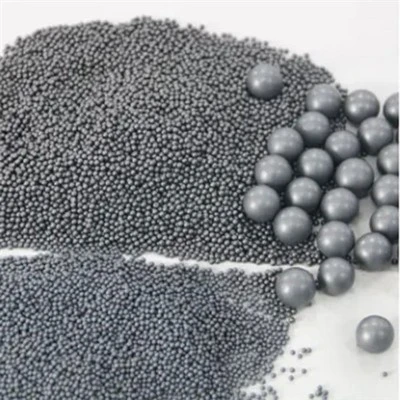


Graphite Beads for Glass Cast Production
Description
Technical Parameters
Graphite Beads for Glass Cast Production are spherical graphite components manufactured for high-temperature glass casting and forming processes where controlled dimensions, thermal stability and clean contact characteristics are required.
Manufactured from selected graphite materials, these beads can be supplied with customized diameters, graphite grades and surface requirements to meet different glass casting process conditions.

Performance in Glass Casting
Reduced Glass Adhesion
Graphite's low surface energy helps reduce adhesion and material buildup during contact with molten glass.
Thermal Stability
Low thermal expansion helps the beads retain their shape during repeated heating and cooling.
High Material Purity
High-purity graphite helps limit ash and other impurities that may affect glass processing.
Applications
Glass Bead Manufacturing Equipment
Used as graphite components in glass bead production equipment requiring stable high-temperature performance and low sticking characteristics.
Decorative & Industrial Glass Processing
Suitable for glass forming operations where graphite components are exposed to molten glass contact and repeated thermal cycles.
Glass Casting Lines
Used in glass casting production lines where controlled graphite bead dimensions and material properties are required for consistent processing.
Customized Glass Production Systems
Used in customer-designed casting equipment where bead dimensions, graphite grade and surface requirements are specified according to the equipment or process conditions.
Dimensional & Surface Inspection
Bead Diameter Measurement
A digital caliper or micrometer is used to measure bead diameter at multiple positions. Results are checked against the specified diameter and tolerance, and out-of-tolerance pieces are rejected.
Spherical Shape Inspection
Each batch is visually checked for deformation, flattened areas and obvious irregular profiles. Non-conforming beads are removed before packing.
Surface Defect Inspection
The bead surface is checked for cracks, chips, pits, scratches and visible foreign matter. Defective pieces are separated from the qualified batch.
Surface Finish Verification
Finished surfaces are checked against the specified finish requirement to identify inconsistent processing or visible surface defects.
Custom Graphite Beads
|
Customization Parameter |
Available Options |
|
Bead Diameter |
Custom dimensions according to drawing or specification |
|
Dimensional Tolerance |
Defined according to customer requirements |
|
Graphite Grade |
Selected according to application temperature and purity requirements |
|
Surface Finish |
Customized according to contact requirements |
|
Density & Porosity |
Controlled according to graphite grade specification |
|
Packaging |
Export packaging according to order quantity |
For customized production, customers can provide a technical drawing, existing specification or sample for review.
Quality Documentation
Material Verification
Graphite raw material characteristics, including density, purity and relevant physical properties, can be checked according to agreed technical requirements.
Inspection Records
Inspection results for applicable material and finished-product characteristics can be provided according to the agreed order requirements.
Specification Compliance
Inspection requirements can be linked to the confirmed drawing, material specification, dimensional tolerance and other agreed product requirements.
Pre-Shipment Documentation
Required quality documents are prepared and checked before shipment according to the agreed documentation requirements.
Packaging & Delivery
Protective Packaging
Graphite beads are securely packed to reduce breakage, contamination and mixing of different product sizes during handling and transportation.
Inner Packaging
Moisture-resistant bags, bulk bags or vacuum packaging can be used according to the product quantity and shipment requirements.
Outer Packaging
Cartons, pallets or wooden cases can be used for export shipments according to the order size and transportation method.
Package Identification
Packages can be marked with product name, bead size, graphite grade and quantity for identification during receiving and warehouse handling.
Ordering Information
For quotation and production review, please provide the following information where applicable:
|
Information |
Required Details |
|
Product Size |
Required bead diameter |
|
Tolerance |
Required dimensional tolerance |
|
Material |
Graphite grade or purity requirement |
|
Quantity |
Trial or bulk order quantity |
|
Application |
Glass casting process or equipment application |
|
Surface Requirement |
Required surface condition, if specified |
|
Drawing / Specification |
Technical drawing, existing specification or sample, if available |
|
Packaging |
Special packaging or labeling requirements |
Providing the complete specification at the RFQ stage helps avoid repeated confirmation before production.


Carbon Graphite Material Data Sheet
| W-4 | W-5 | W-6 | W-7 | W-8 | WH-5 | WH-7 | WH-8 | ||
| Bulk density | G/cm³ | 1.75 | 1.85 | 1.9 | 1.82 | 1.9 | 1.68 | 1.85 | 1.9 |
| Resistivity | uΩm | 8-11 | 8-10 | 8-9 | 11-13 | 11-13 | 13-15 | 11-13 | 11-13 |
| Thermal conductivity(100℃) | W/m.k | 110-120 | 130-140 | 130-140 | 110-120 | 110-120 | 80-100 | 100-120 | 110-120 |
| Thermal expansion coefficient (room temperature - 600℃) | 10-6/℃ | 5.46 | 4.75 | 4.8 | 5.8 | 5.85 | 5.8 | 5.9 | 5.85 |
| Shore Hardness | HSD | 42 | 48 | 53 | 65 | 70 | 60 | 68 | 72 |
| Flexural strength | Mpa | 38 | 46 | 55 | 51 | 60 | 38 | 62 | 70 |
| Compressive strength | Mpa | 65 | 85 | 95 | 115 | 135 | 80 | 135 | 160 |
| Elastic modulus | GPa | 9 | 11.8 | 12 | 12 | 13 | 8.8 | 12 | 13 |
| Porosity | % | 17 | 13 | 11 | 12 | 11 | 18 | 12 | 11 |
| Ash | PPM | 500 | 500 | 500 | 500 | 500 | 500 | 500 | 500 |
| Purification of ash | PPM | 50 | 50 | 50 | 50 | 50 | 50 | 50 | 50 |
| Grain size | Um | 13-15 | 13-15 | 8-10 | 8-10 | 8-10 | 8-10 | 7 | 5 |
| Application | Common use | Common use | Continuous casting, sintering, high temperature metallurgy | EDM,Photovoltaic | EDM,Photovoltaic,GLASS | EDM | Common use,EDM | EDM,Photovoltaic,GLASS |
FAQ
Q: What is the difference between graphite beads and graphite balls?
A: The terms are often used interchangeably for spherical graphite products. In industrial purchasing, the specification should be based on the required diameter, graphite grade, tolerance and application rather than the product name alone.
Q: How do I choose between standard and high-purity graphite?
A: High-purity graphite is preferred when the glass process has tighter limits on ash or foreign material. Standard grades can be used when the process specification permits higher impurity levels.
Q: Does graphite grade affect bead service life?
A: Yes. Graphite density, grain structure, mechanical strength and thermal properties can affect resistance to wear and thermal cycling. The material grade should therefore be matched to the operating conditions.
Q: Can graphite beads be supplied with a Certificate of Analysis (COA)?
A: A COA or equivalent inspection documentation can be supplied when it is included in the agreed quality-documentation requirements for the order.
Q: Can I purchase a small quantity for testing before a production order?
A: Trial or sample orders can be arranged before a bulk order so the bead dimensions and material can be evaluated in the customer's production process.
Q: What causes graphite beads to crack during use?
A: Cracking can result from mechanical impact, excessive thermal shock, improper handling or operating conditions outside the selected graphite grade. Handling and heating conditions should be controlled to avoid sudden mechanical or thermal stress.
Q: How should graphite beads be stored before use?
A: Keep the beads in their original protective packaging in a clean, dry storage area and protect them from moisture, contamination and mechanical impact.
Q: Can graphite beads from different graphite grades be mixed in one production process?
A: Different grades should not be mixed unless the production specification permits it. Material properties can vary between grades and may affect process consistency.
Q: What information should be checked before approving a graphite bead supplier?
A: The key items are graphite grade, bead diameter and tolerance, material inspection data, production consistency, quality documentation, packaging method and the supplier's ability to repeat the same specification for future orders.
Q: Can the same graphite bead specification be supplied for repeat orders?
A: Yes. Repeat orders can be manufactured against the confirmed product specification, including the agreed graphite grade, dimensions, tolerance and other applicable quality requirements.
Hot Tags: graphite beads for glass cast production, China graphite beads for glass cast production manufacturers, suppliers, factory, Copper Carbon Block For Making Carbon Brush, graphite ball, Graphite Balls, Graphite Beads, High Pure Graphite Ball Beads
Previous
High Pure Graphite Ball BeadsSend Inquiry