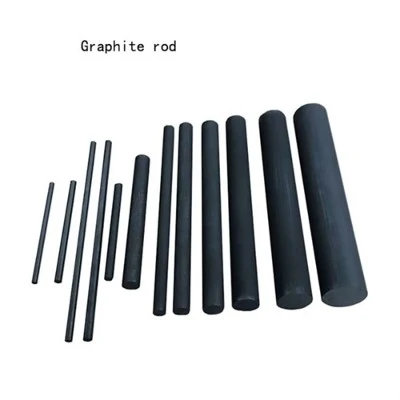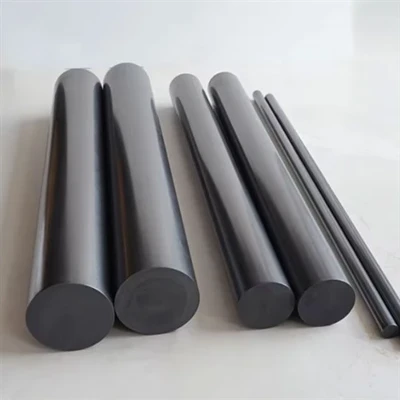

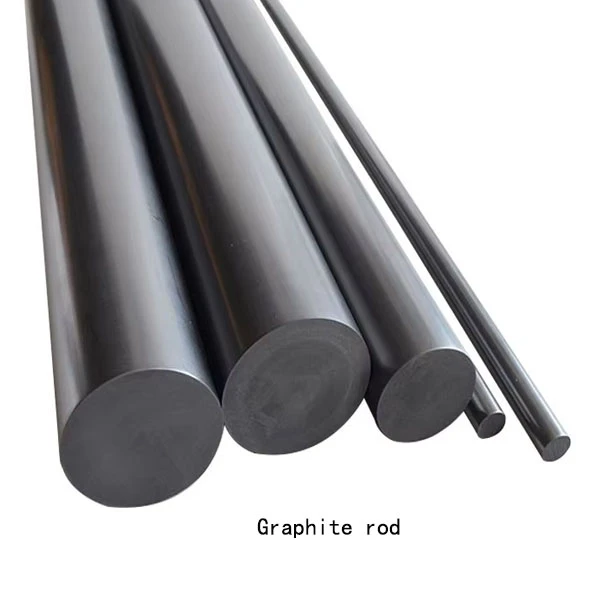
High Quality Graphite Rod Electrode
Description
Technical Parameters
Graphite Rod Electrodes are precision-machined graphite electrodes mainly used for EDM machining, micro-electrode applications, and customized electrical components requiring stable conductivity, low wear, and accurate electrode geometry.

Graphite rod material data sheet for your reference
| W-4 | W-5 | W-6 | W-7 | W-8 | WH-5 | WH-7 | WH-8 | ||
| Bulk density | G/cm³ | 1.75 | 1.85 | 1.9 | 1.82 | 1.9 | 1.68 | 1.85 | 1.9 |
| Resistivity | UΩm | 8-11 | 8-10 | 8-9 | 11-13 | 11-13 | 13-15 | 11-13 | 11-13 |
| Thermal conductivity(100℃) | W/m.k | 110-120 | 130-140 | 130-140 | 110-120 | 110-120 | 80-100 | 100-120 | 110-120 |
| Thermal expansion coefficient (room temperature - 600℃) | 10-6/℃ | 5.46 | 4.75 | 4.8 | 5.8 | 5.85 | 5.8 | 5.9 | 5.85 |
| Shore Hardness | HSD | 42 | 48 | 53 | 65 | 70 | 60 | 68 | 72 |
| Flexural strength | Mpa | 38 | 46 | 55 | 51 | 60 | 38 | 62 | 70 |
| Compressive strength | Mpa | 65 | 85 | 95 | 115 | 135 | 80 | 135 | 160 |
| Elastic modulus | GPa | 9 | 11.8 | 12 | 12 | 13 | 8.8 | 12 | 13 |
| Porosity | % | 17 | 13 | 11 | 12 | 11 | 18 | 12 | 11 |
| Ash | PPM | 500 | 500 | 500 | 500 | 500 | 500 | 500 | 500 |
| Purification of ash | PPM | 50 | 50 | 50 | 50 | 50 | 50 | 50 | 50 |
| Grain size | Um | 13-15 | 13-15 | 8-10 | 8-10 | 8-10 | 8-10 | 7 | 5 |
| Application | Common use | Common use | Continuous casting, sintering, high temperature metallurgy | EDM,Photovoltaic | EDM,Photovoltaic,GLASS | EDM | Common use,EDM | EDM,Photovoltaic,GLASS |


Electrode Construction

Solid Cylindrical Graphite Body
The electrode consists of a solid cylindrical graphite body with a defined diameter and length.
Uniform Cross-Section
The rod maintains a consistent circular cross-section along its working length.
Flat or Machined End Faces
Both ends form defined electrode faces for connection, mounting, or direct use.
Continuous Graphite Structure
The graphite extends continuously through the electrode body without internal joints or assembled sections.
Electrical Performance
Controlled Electrical Resistivity
Available graphite grades provide electrical resistivity of 8–15 μΩ·m, giving buyers a defined electrical parameter for electrode material selection.
Consistent Electrical Path
The solid graphite body provides a continuous conductive path between the electrical connection and working end without joints or assembled conductive sections.
Thermal Stability During Operation
The available grades have thermal expansion coefficients of 4.75–5.90 × 10⁻⁶/°C from room temperature to 600°C, helping limit dimensional change as electrode temperature increases.
Electrode Machining & Inspection
Diameter Inspection
Diameter is measured at the upper, middle, and lower sections, with two perpendicular readings taken at each position using a digital micrometer. The maximum and minimum values are recorded and checked against the specified diameter tolerance.
Length & Straightness Inspection
Overall length is measured with a vernier caliper or length gauge. Straightness is checked on a flat reference surface or inspection fixture using a dial indicator, with the maximum measured deviation compared with the specified limit.
End-Face & Surface Inspection
Electrode ends and the cylindrical surface are visually inspected for chips, cracks, edge damage, pits, and deep machining marks. Defective pieces are removed before packing.
Electrical Resistivity Check
For orders requiring electrical verification, resistivity is measured using a four-point or resistance measurement method. The measured value is compared with the specified material grade or purchase requirement.
Applications
EDM Electrodes
Used as electrode material for electrical discharge machining where controlled geometry and electrical conductivity are required for spark discharge.
Micro-EDM Applications
Small-diameter graphite electrodes can be machined for precision discharge applications where electrode diameter and straightness directly affect the working geometry.
Electrochemical Processing
Used as anode or cathode components in selected electrolysis, electroplating, and electrochemical equipment.
High-Temperature Electrical Components
Used as conductive or heating components in high-temperature equipment operating in controlled atmospheres.
Electrode Configurations
Diameter & Length
Electrode dimensions can be produced to the required working diameter and length.
End Geometry
Available machining includes flat ends, chamfers, ground ends, and other specified end configurations.
Surface Finish
Machined, fine-ground, or polished surfaces can be supplied according to the required electrode surface condition.
Dimensional Tolerance
Critical dimensions can be controlled according to the approved drawing or specified tolerance.
Packaging & Shipment
Individual & End Protection
Electrodes are separated and protected at the ends to reduce chipping, cracking, and surface damage during handling and transportation.
Specification Separation
Different diameters, lengths, and graphite grades are packed and identified separately to prevent specification mixing.
Export Packaging
Products are packed in cartons or wooden cases according to electrode dimensions, quantity, and transportation requirements.
Package Identification
Labels can include product name, dimensions, graphite grade, quantity, and batch/lot number for receiving inspection.
After-Sales & Order Support
Pre-Production Confirmation
Final dimensions, graphite grade, tolerances, end geometry, quantity, and inspection requirements are confirmed before production.
Quality Issue Review
Reported quality issues are reviewed against the approved specification and available inspection records.
Repeat-Order Reference
Approved drawings and production specifications can be retained as references for subsequent orders.
FAQ
Q: How do I choose between fine-grain and coarse-grain graphite electrodes?
A: Fine-grain graphite is generally preferred for small or detailed electrodes, while coarser grades may be selected for applications where larger electrode sections and different mechanical or thermal properties are required.
Q: Does electrode diameter affect machining accuracy?
A: Yes. Smaller electrode diameters are more sensitive to straightness, runout, clamping alignment, and machining damage, so dimensional control becomes increasingly important as the electrode size decreases.
Q: What electrode shape is best for deep EDM cavities?
A: Long, slender electrodes can be used for deep cavities, but the electrode geometry must provide sufficient rigidity and maintain alignment during machining to limit deflection.
Q: How does graphite electrode porosity affect EDM use?
A: Porosity affects the material's density, mechanical strength, and surface characteristics. Lower-porosity graphite can be advantageous where a more compact and mechanically stable electrode structure is required.
Q: How should a graphite electrode be clamped in an EDM machine?
A: The electrode should be clamped concentrically and with sufficient contact area to maintain alignment without applying excessive mechanical force that could chip or fracture the graphite.
Q: Can graphite electrodes be re-machined after use?
A: Yes. A used electrode can be re-machined when sufficient material remains and its geometry can be restored within the required dimensional limits.
Q: What causes graphite electrodes to chip at the edges?
A: Edge chipping can result from excessive mechanical pressure, unsuitable machining parameters, poor clamping, impact during handling, or insufficient support of thin electrode sections.
Q: How should unused graphite electrodes be stored?
A: Store them in a dry, clean environment with the original protective packaging maintained until use. Thin or small-diameter electrodes should be supported to prevent bending and accidental impact.
Q: How can I order replacement graphite electrodes with the same geometry?
A: Provide the previous electrode drawing, sample, or measured dimensions together with the graphite grade and critical tolerances. These references can be used to establish the replacement specification.
Q: What should I check when evaluating a graphite electrode supplier?
A: Check the supplier's graphite material control, machining capability, dimensional inspection method, ability to maintain repeat-order specifications, inspection documentation, and experience with export orders.
Hot Tags: high quality graphite rod electrode, China high quality graphite rod electrode manufacturers, suppliers, factory, carbon graphite products, graphite rod, Graphite Rod in Nuclear Reactor, Graphite Rods Arc Furnace, High Pure Graphite Rod, High Quality Graphite Rod Electrode
Previous
Graphite Rod in Nuclear ReactorNext
No InformationSend Inquiry